
Mastering Agile Development: A Comprehensive Guide for Success
In today’s fast-paced business landscape, the ability to adapt quickly and deliver value efficiently is paramount. Traditional project management methodologies, often rigid and linear, frequently struggle to keep pace with evolving requirements and market demands. This is where agile development guide steps in, offering a flexible, iterative, and highly collaborative approach to project management and software development. Agile is not just a methodology; it’s a mindset, a philosophy that prioritizes individuals and interactions over processes and tools, working software over comprehensive documentation, customer collaboration over contract negotiation, and responding to change over following a plan.
This comprehensive agile development guide will delve into the core principles of agile, explore its most popular methodologies, discuss the benefits it brings, and provide practical steps for successful implementation. Whether you are a seasoned project manager, a software developer, or a business leader looking to enhance your team’s productivity and responsiveness, understanding and adopting agile practices can be a game-changer.
What is Agile Development? Understanding the Core Principles
At its heart, agile development is an iterative and incremental approach to delivering projects. Instead of attempting to deliver everything at once, agile breaks down projects into smaller, manageable chunks called iterations or sprints. Each iteration typically lasts 1-4 weeks and results in a potentially shippable increment of the product. This allows for continuous feedback, early detection of issues, and the flexibility to adapt to changing requirements throughout the project lifecycle.
The Agile Manifesto, created in 2001 by seventeen independent-minded software practitioners, outlines four core values and twelve supporting principles that define the agile approach:
Advertisements
The Four Core Values of Agile:
- Individuals and interactions over processes and tools
- Working software over comprehensive documentation
- Customer collaboration over contract negotiation
- Responding to change over following a plan
These values emphasize the human element, practical output, partnership with customers, and adaptability. They serve as the foundation for all agile methodologies and practices.
The Twelve Principles Behind the Agile Manifesto:
- Our highest priority is to satisfy the customer through early and continuous delivery of valuable software.
- Welcome changing requirements, even late in development. Agile processes harness change for the customer’s competitive advantage.
- Deliver working software frequently, from a couple of weeks to a couple of months, with a preference to the shorter timescale.
- Business people and developers must work together daily throughout the project.
- Build projects around motivated individuals. Give them the environment and support they need, and trust them to get the job done.
- The most efficient and effective method of conveying information to and within a development team is face-to-face conversation.
- Working software is the primary measure of progress.
- Agile processes promote sustainable development. The sponsors, developers, and users should be able to maintain a constant pace indefinitely.
- Continuous attention to technical excellence and good design enhances agility.
- Simplicity—the art of maximizing the amount of work not done—is essential.
- The best architectures, requirements, and designs emerge from self-organizing teams.
- At regular intervals, the team reflects on how to become more effective, then tunes and adjusts its behavior accordingly.
These principles provide a deeper understanding of how to apply the agile values in practice, fostering a culture of continuous improvement, collaboration, and customer focus. This agile development guide aims to simplify these concepts for practical application.
Popular Agile Methodologies: Scrum, Kanban, and More
While agile is a broad philosophy, several specific methodologies have emerged to put its principles into practice. The most widely adopted include Scrum and Kanban, each with its unique characteristics and strengths.
Scrum: The Framework for Complex Product Development
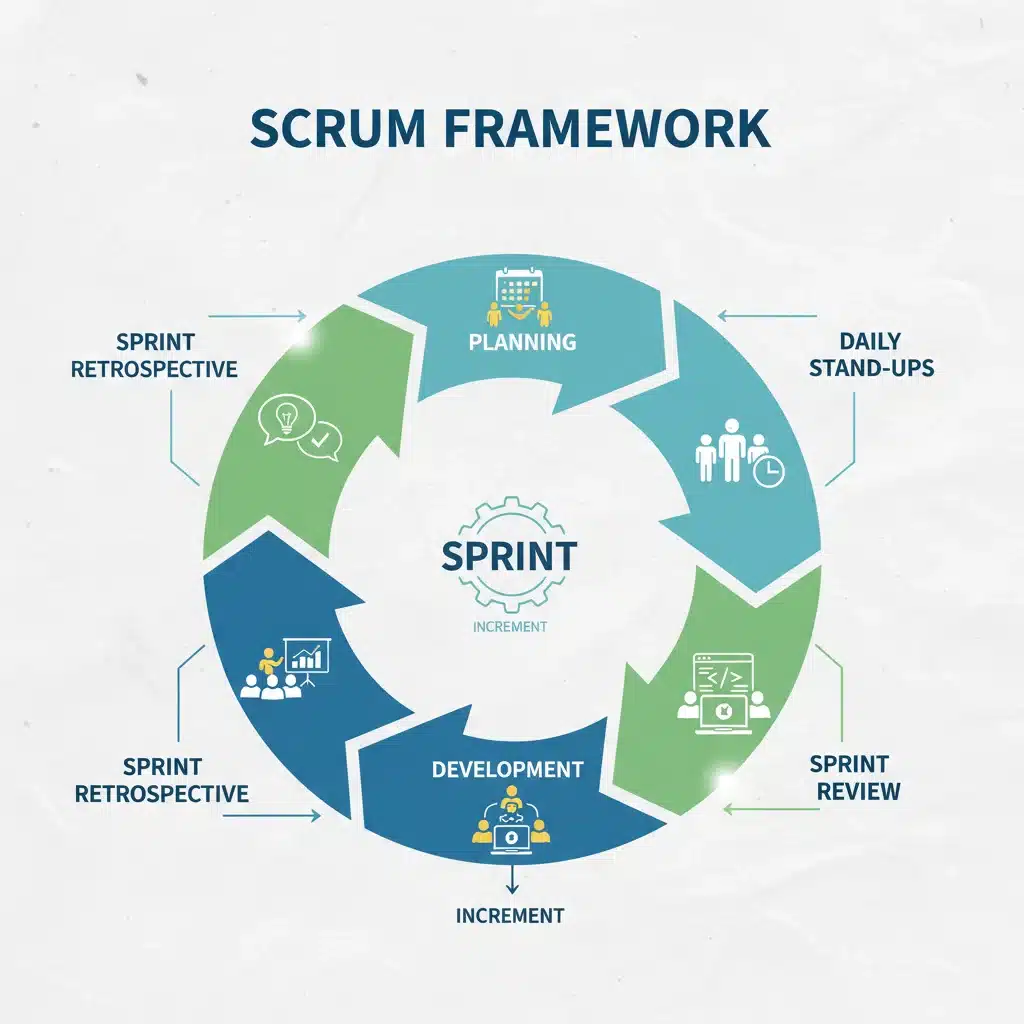
Scrum is an empirical process framework for developing and sustaining complex products. It is lightweight, simple to understand, but difficult to master. Scrum emphasizes a small, self-organizing, cross-functional team working in short, time-boxed iterations called sprints (typically 1-4 weeks).
Key components of Scrum include:
- Product Owner: Responsible for maximizing the value of the product resulting from the work of the Development Team. Manages the Product Backlog.
- Scrum Master: Serves the team in a servant-leader capacity, ensuring Scrum is understood and enacted. Facilitates Scrum events and removes impediments.
- Development Team: A self-organizing, cross-functional group of professionals who do the work of delivering a potentially shippable increment of product at the end of each sprint.
- Scrum Events:
- Sprint Planning: The team plans the work to be performed in the upcoming sprint.
- Daily Scrum (Stand-up): A 15-minute time-boxed event for the Development Team to synchronize activities and create a plan for the next 24 hours.
- Sprint Review: The Development Team presents the results of their work to key stakeholders and collects feedback.
- Sprint Retrospective: The team inspects how the last sprint went with regards to individuals, interactions, processes, and tools, and identifies improvements.
- Scrum Artifacts:
- Product Backlog: An ordered list of everything that might be needed in the product.
- Sprint Backlog: The set of Product Backlog items selected for the Sprint, plus a plan for delivering the product increment and realizing the Sprint Goal.
- Increment: The sum of all the Product Backlog items completed during a Sprint and the value of the increments of all previous Sprints.
Scrum’s iterative nature and focus on continuous feedback make it highly effective for projects with evolving requirements. This agile development guide highlights Scrum as a cornerstone for many organizations.
Kanban: Visualizing Workflow and Limiting Work in Progress (WIP)
Kanban, originating from Japanese manufacturing, is a method for managing and improving work across human systems. It emphasizes continuous delivery while not overburdening the development team. Kanban is less prescriptive than Scrum and is often used to visualize workflow, limit work in progress (WIP), and maximize efficiency.
Key principles of Kanban include:
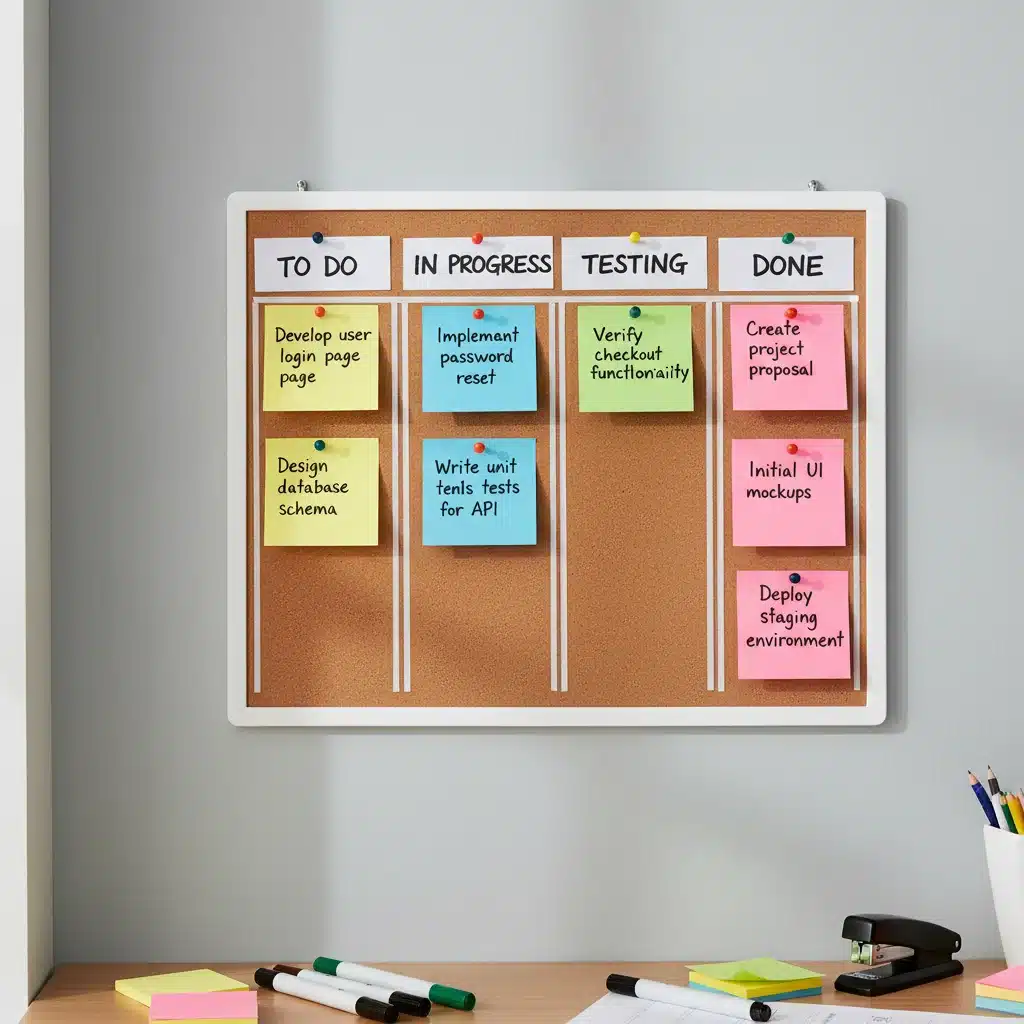
- Visualize the workflow: Use a Kanban board (physical or digital) with columns representing different stages of the workflow (e.g., To Do, In Progress, Testing, Done).
- Limit Work in Progress (WIP): Set explicit limits on the number of items that can be in progress at each stage. This helps identify bottlenecks and encourages flow.
- Manage flow: Monitor, measure, and improve the flow of work through the system.
- Make process policies explicit: Clearly define the rules for how work moves through the system.
- Implement feedback loops: Regularly review and adjust the process.
- Improve collaboratively, evolve experimentally: Encourage continuous improvement based on data and team input.
Kanban is particularly well-suited for maintenance projects, continuous delivery, or situations where requirements are constantly changing and there isn’t a fixed release schedule. It provides flexibility and a clear visual representation of work status. Understanding Kanban is crucial for a comprehensive agile development guide.
Other Agile Approaches: Lean, XP, and Crystal
- Lean Software Development: Based on lean manufacturing principles, it focuses on eliminating waste, amplifying learning, deciding as late as possible, delivering as fast as possible, empowering the team, building integrity in, and seeing the whole.
- Extreme Programming (XP): A disciplined approach to delivering high-quality software quickly and continuously. It emphasizes practices like pair programming, test-driven development (TDD), continuous integration, and frequent releases.
- Crystal: A family of agile methodologies, each tailored to different project characteristics (e.g., Crystal Clear for small, non-critical projects; Crystal Orange for larger, more complex ones). It values communication, safety, focus, and frequent delivery.
Benefits of Adopting an Agile Development Approach
Implementing an agile approach offers numerous advantages for organizations, teams, and customers alike. This section of our agile development guide highlights the most significant benefits:
1. Faster Time to Market and Continuous Delivery
By breaking down projects into smaller, iterative cycles, agile teams can deliver working software more frequently. This means new features and improvements can reach users faster, providing immediate value and allowing organizations to respond quickly to market changes and competitive pressures. The continuous delivery aspect reduces the risk associated with large, infrequent releases.
2. Enhanced Customer Satisfaction
Agile places a strong emphasis on customer collaboration and feedback throughout the development process. Customers are actively involved in reviewing increments, providing input, and prioritizing features. This ensures that the final product truly meets their needs and expectations, leading to higher satisfaction levels.
3. Improved Quality and Reduced Risk
Frequent testing, continuous integration, and regular feedback loops inherent in agile methodologies help identify and address defects early in the development cycle. This proactive approach leads to higher product quality and reduces the risk of major issues emerging late in the project. The iterative nature also allows for early course correction if initial assumptions prove incorrect, mitigating project risks.
4. Greater Flexibility and Adaptability
One of agile’s most significant strengths is its ability to embrace change. Unlike traditional methods that struggle with scope creep, agile processes welcome evolving requirements. Teams can pivot quickly, reprioritize tasks, and adapt to new information without derailing the entire project. This adaptability is crucial in dynamic environments.
5. Increased Team Productivity and Morale
Agile promotes self-organizing, cross-functional teams that have autonomy over how they accomplish their work. This empowerment, combined with clear goals, regular feedback, and a focus on collaboration, often leads to higher team morale, increased motivation, and improved productivity. Teams feel a greater sense of ownership and responsibility for the product.
6. Better Project Predictability and Transparency
While agile embraces change, it also provides mechanisms for better predictability. Through sprint planning, daily stand-ups, and visual boards like Kanban, the progress of the project is highly transparent. Stakeholders have a clear understanding of what’s being worked on, what’s complete, and what challenges exist, leading to more realistic expectations and better forecasting.
Implementing Agile: Practical Steps for Success
Adopting agile is a journey, not a destination. It requires a shift in mindset, culture, and processes. This agile development guide offers practical steps to help organizations successfully implement agile practices:
1. Start Small and Iterate
Don’t try to implement agile across your entire organization overnight. Begin with a single project or a small team. This allows you to learn, adapt, and refine your agile practices before scaling them. Treat your agile adoption itself as an agile project – start with a minimum viable product and iterate.
2. Secure Leadership Buy-in and Support
Agile transformation requires strong support from leadership. Leaders need to understand the principles, champion the change, and provide the necessary resources and environment for agile teams to thrive. Their commitment is vital for overcoming resistance and fostering a culture of agility.
3. Train Your Teams
Provide comprehensive training for all team members involved, including product owners, scrum masters, developers, and even stakeholders. Ensure everyone understands the chosen agile methodology (e.g., Scrum, Kanban), their roles, and the expected practices. This foundational knowledge is critical for effective collaboration.
4. Form Cross-Functional, Self-Organizing Teams
Agile teams should ideally be small (5-9 members), cross-functional (possessing all skills needed to deliver a working increment), and self-organizing (empowered to decide how best to accomplish their work). Foster an environment of trust and psychological safety where teams can experiment and learn.
5. Define Clear Roles and Responsibilities
While agile promotes collaboration, clear roles (e.g., Product Owner, Scrum Master, Development Team) are essential, especially in Scrum. Ensure everyone understands their responsibilities and how they contribute to the overall project success.
6. Establish a Product Backlog and Prioritization Process
A well-maintained Product Backlog is the single source of truth for all work to be done. It should be continuously refined and prioritized based on business value, customer feedback, and technical feasibility. The Product Owner plays a crucial role in managing this backlog.
7. Embrace Iterative Development and Feedback Loops
Conduct regular sprints or iterations, ensuring that each one delivers a potentially shippable increment. Integrate frequent feedback loops, such as sprint reviews and retrospectives, to inspect the product and the process, and adapt accordingly. Continuous improvement is a cornerstone of agile.
8. Foster Transparency and Communication
Use visual management tools like Scrum boards or Kanban boards to make work transparent. Encourage open and honest communication within the team and with stakeholders. Daily stand-ups are excellent for quick information sharing and identifying impediments.
9. Invest in Tools and Technology
While agile values individuals and interactions over tools, appropriate tools can significantly enhance efficiency. Consider using project management software (Jira, Trello, Asana), collaboration platforms, and continuous integration/continuous delivery (CI/CD) pipelines to support your agile processes.
10. Be Prepared for Cultural Shift and Resistance
Agile adoption often involves a significant cultural shift. Be prepared for resistance from individuals accustomed to traditional methods. Address concerns, communicate the ‘why’ behind the change, and celebrate small successes to build momentum. Patience and persistence are key.
Common Challenges in Agile Adoption and How to Overcome Them
While the benefits of agile are compelling, organizations often face challenges during its implementation. This agile development guide wouldn’t be complete without addressing these hurdles:
1. Resistance to Change
Challenge: People are naturally resistant to change, especially when it involves new ways of working, different roles, or increased transparency.
Solution: Communicate the benefits clearly, involve team members in the decision-making process, provide adequate training and support, and celebrate early successes to build buy-in.
2. Lack of Management Support or Understanding
Challenge: If management doesn’t fully understand or commit to agile principles, they might impose traditional metrics or processes that undermine agile efforts.
Solution: Educate leadership on agile values and benefits. Demonstrate tangible results from pilot projects. Align organizational goals with agile outcomes.
3. Difficulty in Estimating and Planning
Challenge: Agile’s iterative nature can make long-term planning and fixed-scope commitments challenging, leading to frustration from stakeholders used to detailed upfront plans.
Solution: Focus on relative sizing (e.g., story points) rather than absolute time estimates. Use historical data (velocity) for forecasting. Emphasize adaptive planning and continuous communication about evolving scope.
4. Inadequate Product Owner Role
Challenge: A Product Owner who lacks authority, availability, or understanding of the product vision can become a bottleneck, leading to unclear requirements or poor prioritization.
Solution: Ensure the Product Owner is empowered, dedicated, and has a strong understanding of the business and customer needs. Provide training and coaching for this critical role.
5. Technical Debt and Legacy Systems
Challenge: Integrating agile with existing legacy systems or dealing with significant technical debt can hinder rapid iteration and continuous delivery.
Solution: Prioritize refactoring and addressing technical debt as part of the regular sprint work. Implement automated testing and continuous integration to manage the complexity of legacy systems.
6. Distributed Teams
Challenge: While agile emphasizes face-to-face communication, many teams are distributed, which can complicate collaboration and communication.
Solution: Leverage effective communication tools (video conferencing, chat), establish clear communication protocols, ensure overlapping work hours, and consider occasional in-person meetings for critical planning or team building.
7. Over-reliance on Tools
Challenge: Some organizations mistakenly believe that simply adopting agile tools will make them agile, neglecting the underlying cultural and procedural changes.
Solution: Remember that tools support agile, but they don’t define it. Focus on principles, values, and practices first. Choose tools that genuinely facilitate collaboration and transparency rather than dictating the process.
The Future of Agile Development
Agile is no longer confined to software development; its principles are being applied across various industries and functions, from marketing and HR to manufacturing and education. The concept of ‘Business Agility’ is gaining traction, emphasizing the ability of an entire organization to respond quickly to market changes and customer demands.
Trends like DevOps, which extends agile principles to operations, and the increasing adoption of AI and machine learning in project management, will continue to shape the future of agile. Scaled agile frameworks like SAFe (Scaled Agile Framework), LeSS (Large-Scale Scrum), and Nexus are helping larger enterprises apply agile at scale, managing multiple interdependent teams and complex portfolios.
As organizations continue to navigate an increasingly volatile, uncertain, complex, and ambiguous (VUCA) world, the adaptability and resilience offered by agile development will remain invaluable. This agile development guide serves as a starting point for embracing this powerful paradigm.
Conclusion: Embracing Agility for Enduring Success
Agile development is more than just a set of practices; it’s a fundamental shift in how we approach work, emphasizing collaboration, customer value, and continuous improvement. By understanding and applying the principles outlined in this agile development guide, organizations can significantly enhance their ability to deliver high-quality products, respond effectively to change, and foster a more engaged and productive workforce.
The journey to becoming truly agile requires commitment, patience, and a willingness to learn and adapt. It’s about building a culture where feedback is valued, experiments are encouraged, and continuous delivery of value is the ultimate goal. Embrace the agile mindset, empower your teams, and watch your projects, and indeed your entire organization, thrive in the dynamic landscape of the modern world.
We hope this comprehensive agile development guide has provided you with the insights and tools you need to embark on or continue your agile journey successfully. The rewards of agility – faster delivery, happier customers, and more engaged teams – are well worth the effort.